
When people think of classic aquarium fish, the platy is often one of the first that comes to mind: peaceful, colourful and almost ordinary at first glance. But behind this small fish is a story that stretches from Central American waterways all the way to modern cancer research. In this guide, I cover how to keep and breed platies, where they come from and what makes their biology so special.
Prefer to watch? My full platy documentary is in the video below.
Platy fish at a glance
- Scientific name: Xiphophorus maculatus (or Southern platyfish in English)
- Family: Poeciliidae (livebearers), like guppies and endlers lifebearers
- Size: females up to 6 cm (2.5 in), males around 4 cm (1.5–2 in)
- Tank size: around 60 litres (15 gallons) or more for a small group are recommended
- Temperature: 22–28 °C (70–82 °F)
- Water: slightly alkaline, moderately hard
- Temperament: peaceful and social
How to keep platy fish
Keeping platies is quite easy, which is part of why they have been popular for generations. A small group lives comfortably in a tank of around 60 litres with stable water parameters.
Platies are omnivores. They do best on a varied diet of high-quality flakes and pellets, supplemented with algae-based foods and occasional small live or frozen food. In my tanks, they also graze on algae, biofilm and the roots of floating plants.
Tank mates: platies are excellent companions for other calm community fish with similar water requirements. I keep my group in a 200-litre (52-gallon) planted community tank with dwarf cichlids and tetras. Amano shrimp or plecos are other good options.
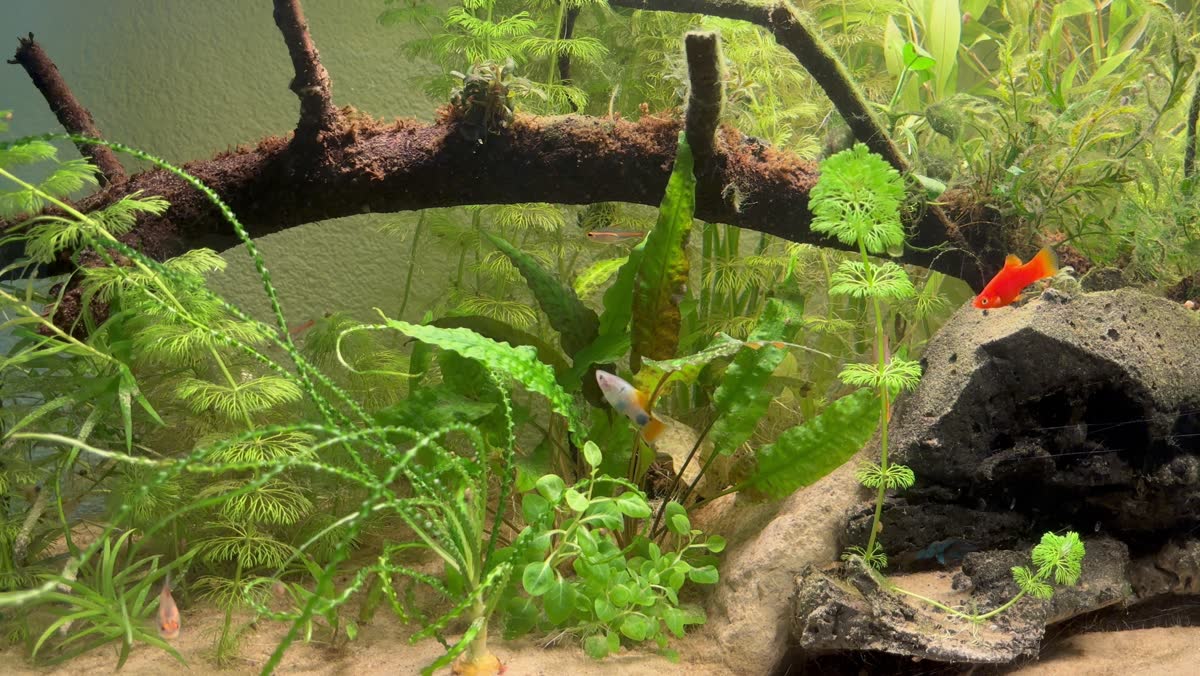
My platies share a planted 200-litre community tank with dwarf cichlids, tetras and corydoras.
I feed them every day with a mix of flakes and pellets, sometimes supplemented with live or frozen food. The results have been amazing: after less than half a year I already had multiple generations of healthy, strong offspring.
Where platies come from
Unlike guppies, platies are not South American. Their home is the Atlantic slope of Central America, from the lowlands of Veracruz in Mexico down to northern Belize. They live in slow-moving rivers, shallow ditches, swamps and densely vegetated banks: warm, often murky waters where conditions change constantly.
I even discovered some platy fish in the wild in a warm spring in the middle of the Austrian alps, check out the video here:
That's where the platy shines. It is a true generalist that tolerates a wide range of temperatures, alkaline water and moderate hardness. This adaptability is also why platies have established invasive populations in at least 28 countries, mostly through released or escaped aquarium fish. So never release aquarium fish into the wild.
The name and its history
Xiphophorus comes from Greek and means "sword bearer". Funny, because the platy has no sword at all, unlike its close relative, the green swordtail. Genetically, though, the potential is there. The platy was first described in 1866 by Albert Günther, originally under the genus Platypoecilus, which is where the name "platy" comes from. A fun side fact: Günther was born in Esslingen am Neckar, just an hour's drive from where I live (in Heilbronn at the Neckar).
Males vs. females
Platies show clear sexual dimorphism. Females are larger and more robust, reaching up to 6 cm. Males stay smaller at around 4 cm and carry a gonopodium, a modified anal fin used for internal fertilisation – the defining feature of livebearers.
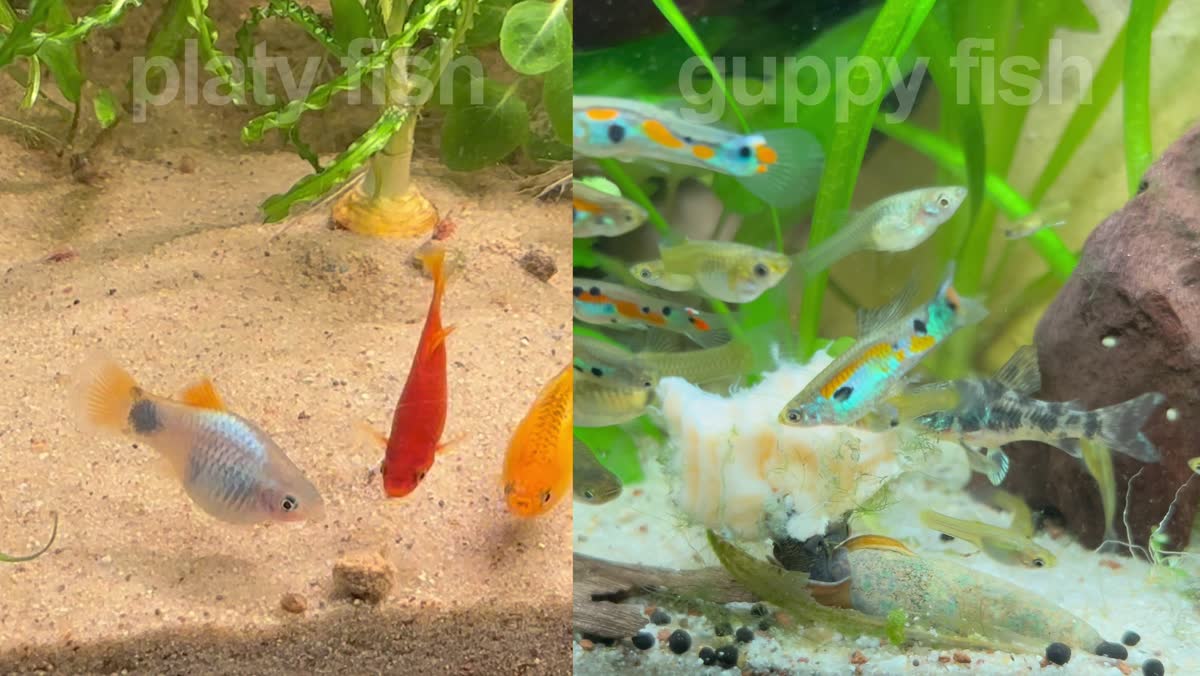
Platies (left) and guppies (right) belong to the same family of livebearers but look quite different.
Colours and their role in cancer research
The species name maculatus means "spotted". Platies display intricate combinations of black, yellow and red pigments, and these patterns are inherited predictably. Many of my platies carry a black spot that is passed on to the next generations.
In the 1920s, scientists Myron Gordon and Curt Kosswig discovered that when certain platies were crossed with green swordtails, some of the offspring developed skin cancer. For the first time, researchers could link cancer directly to inherited genetic information, laying the groundwork for what we now call oncogenes. To this day, the platy remains an important model in skin cancer and tumour research.
Breeding platy fish
Platies are livebearers: the eggs develop inside the female, and after roughly 28 to 30 days she gives birth to fully formed, free-swimming fry. A single brood can range from 20 to 80 young.
- Early colours: unlike guppy fry, you can often tell the colour pattern of platy fry within the first few days.
- Sperm storage: after a single mating, a female can produce several broods without further contact with a male.
- Hiding spots: dense plants and floating plants help fry survive in a community tank.
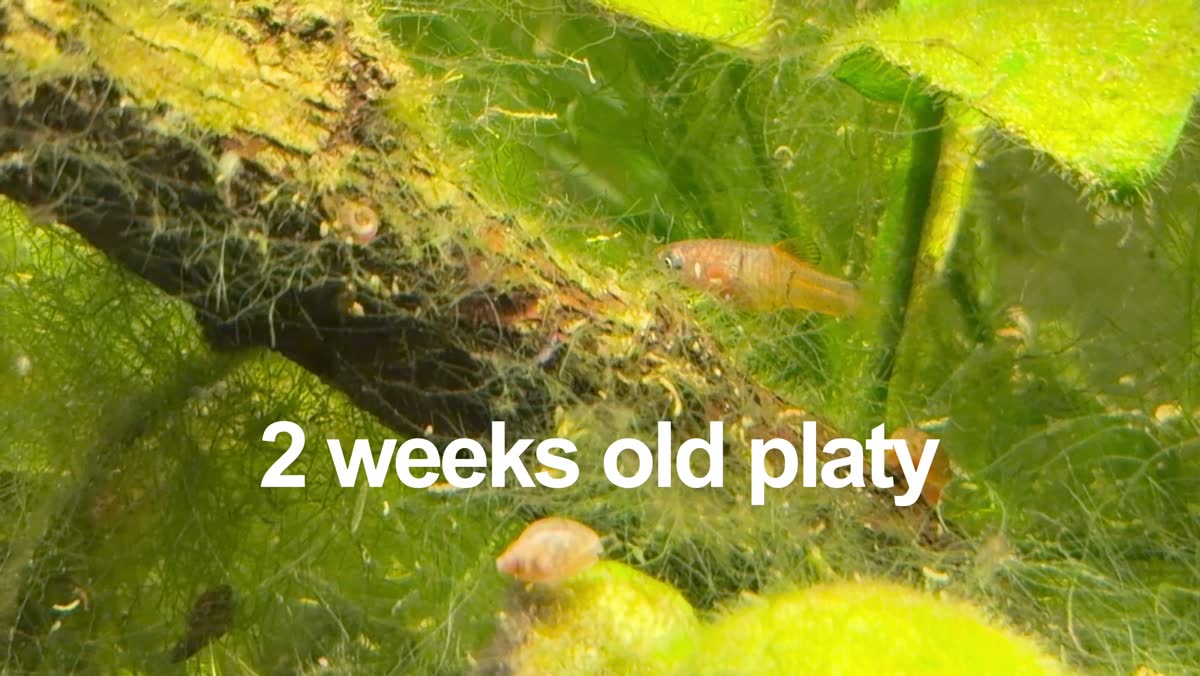
A two-week-old platy fry grazing in the plants. Colours often show very early.
FAQ
How many platies should I keep together?
Platies are social fish, so keep them as a small group. A tank of around 60 litres or more is a good start. I would aim for at least 6 fish, they will quickly multiply and form a group of 15-20 fish.
What do platy fish eat?
They are omnivores: high-quality flakes and pellets, algae-based foods and occasional live or frozen food.
How often do platies have babies?
The gestation period is about 28–30 days, with 20–80 fry per female each brood. Thanks to sperm storage, females can give birth several times after one mating.
Can platies live with guppies?
Platies are peaceful community fish and get along with other calm species with similar water requirements.
Watch the full tank build:
See my platies, their fry and the story of how i built their tank: